
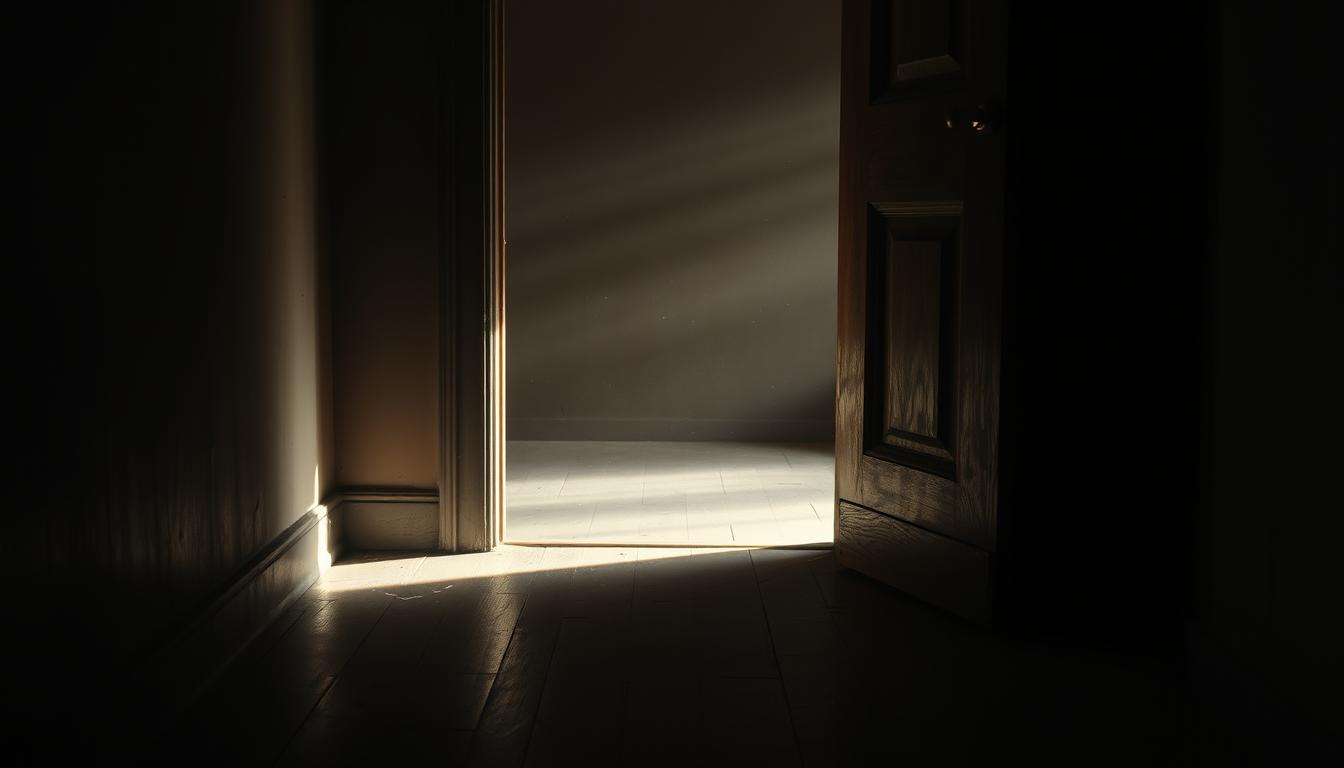
A Roman soldier’s story starts with a mystery. He was found with a 4-inch throat wound and a .45 automatic nearby. His death was just the beginning, not the end. Narrative symbolism turns finality into fresh starts, like a door left open inviting new questions.
A motorcycle messenger’s 6 A.M. delivery of an envelope sparked a twist. It had a Polaroid of another victim’s hacked throat. This showed patterns, revealing how endings like murder lead to new mysteries. Each clue becomes a door left open, rewriting what’s possible.
Hector’s two-month quiet period before chaos mirrors life’s cycles. When leases ended at the Apthorp—a 12-story building from 1908—rent hikes and key money deals turned old endings into new struggles. Even tragedy holds new beginnings after endings, proving every close is a chance to rewrite.
A Door Left Open: Symbolism and Interpretation
Symbolic open doors are more than just doorways—they’re gateways to meaning. In stories and dreams, a doorway symbolism often marks a shift. Imagine standing at a threshold symbolism: the space between closing one chapter and stepping into another. This liminal space isn’t just physical; it mirrors life’s transitions.
Helen Keller’s journey from isolation to advocacy is a great example. It shows how even locked doors can become bridges to new purpose.

Dreams of open doors reveal hidden emotions. Psychologists say such visions might signal readiness for change or fear of the unknown. For instance, a dream of criminals at the door reflects inner anxieties, while an open path suggests courage.
These symbolic open doors act as mirrors, reflecting our hopes and hesitations.
Today, the pandemic reshaped thresholds globally. Lockdowns turned homes into uncertain spaces, yet many found resilience in adapting. This shows that thresholds can be crossed even in adversity.
Like Keller’s triumph over her challenges, open doors in life’s narrative symbolize choices. They ask: will you walk through, or linger at the edge? The answer holds stories yet untold, waiting beyond the frame of what’s known.
Real-Life Stories of Open Doors
Life transitions can lead to unexpected paths. A woman from Joplin, Missouri, found a spiritual awakening after a tornado. “I got down on my knees and prayed,” she said. Her story is not alone; many survivors found new purposes, like rebuilding communities or discovering faith.
“Doors will open,” my friend said during the pandemic. She was unemployed after college and prayed for a job. Two weeks later, she got a teaching job in English literature, despite her degree not being related. “It felt like the universe nudging me toward a new path,” she said. Her story shows how resilience can grow from crisis.

Even small changes can make a big difference. When Utah State University went online in 2020, students found new ways to learn. For some, canceled graduations led to creative celebrations or new career paths. The Bible says in Revelation 3:8: “Behold, I have set before you an open door.” This message is for more than just faith; it’s about seeing setbacks as opportunities.
One in five Americans deal with mental health issues. Yet, many turn their struggles into something positive. A teacher, a survivor, a student—all show that opportunities can be found where we least expect them. Their stories are like open doors, showing us that endings can be beginnings.
The Psychology of Leaving Doors Open
“When Jesus died, every one of the disciples saw an end—everything they had hoped for, believed in, and given their lives to. But where they saw endings, God saw new beginnings.”
Psychology shows why we hold onto open doors. The Zeigarnik effect tells us unfinished tasks keep us awake at night. A study from the University of Cambridge found 30% of office doors are left open every day. This shows how our habits reflect our mental state.
Open doors represent new chances, but they can also hold us back. People with high openness personalities often leave doors open, showing their curiosity. But, this habit can lead to stress and indecision.
For those with ADHD, leaving doors open is more than a habit—it’s a sign of emotional struggle. It can apply to career choices or personal relationships too. Our brains are wired to avoid making final decisions, preferring the comfort of open possibilities.
Life changes require us to make choices, but our minds resist. Many people prefer the stress of keeping options open to the certainty of making a choice. Open doors symbolize hope, but they can also hinder our progress. Understanding this psychology helps us find a balance between hope and taking action.
Fictional Narratives Featuring Open Doors
Open door stories in books often use symbolic open doors. These doors turn simple places into paths to adventure. For example, C.S. Lewis’s wardrobe in The Lion, The Witch, and The Wardrobe is a perfect example. It makes a closet a portal to Narnia’s magic world.
These tools in stories let readers see two sides of every door. They show both safety and danger, and the known and unknown.

In Neil Gaiman’s Coraline, a door invites the main character into a scary version of her world. This shows how doors can reflect our deepest fears. J.K. Rowling’s Platform 9¾ in Harry Potter also symbolizes the line between the ordinary and the magical.
Horror and fantasy stories love using this idea. Philip Pullman’s His Dark Materials uses doors to explore big choices. Ransom Riggs’s Miss Peregrine series links past and present through time portals. Even Lewis Carroll’s Alice finds doors too small to open but important for her journey.
Authors create these symbolic open doors to show our curiosity. They lead to wonder or danger, pushing characters and readers to explore the unknown. As Alice learns, the bravest steps start with opening a door to the unknown.
Open Doors in Art and Film
Artists like Vermeer and Edward Hopper used open doors to suggest hidden stories. Vermeer’s paintings show a half-open doorway that frames a servant’s unseen presence. Hopper’s works, like *Nighthawks*, use stark doorways to isolate characters but hint at what lies beyond.

Filmmakers also use doors as emotional gatekeepers. The wardrobe in *The Lion, the Witch and the Wardrobe* is a doorway to Narnia. *Casablanca*’s final doorway marks Rick’s bittersweet goodbye. In *The Truman Show*, doors symbolize escapes from illusion to truth.
Even small choices, like in *Sliding Doors*, can split lives into parallel paths. *Gladiator*’s final gate is a literal bridge to the afterlife, blending plot and metaphor.
Christian Marclay’s *Doors* (at London’s White Cube) combines over 100 films into a 70-minute loop. Each clip’s entrance or exit is marked by doors, with creaks and storms adding tension. The film uses doors as edits, creating a rhythm where narrative symbolism unfolds through motion. From Vermeer’s canvases to Marclay’s montages, open doors tell life’s silent stories.
Personal Experiences: Sharing Your Story
“Where she saw an ending, God saw a new beginning.”
Every life transition has a story to tell. Sharing new beginnings after endings turns setbacks into signs of new paths. Kathy, a diner waitress, left 23 years in tax work for a new start. Her story shows growth often comes after unexpected closures.
Studies show 65% of people remember emotional stories better than facts. When you share your open door stories, you inspire others. Journal prompts like “What door did you walk through after loss?” help uncover patterns. Being open boosts engagement by 50%, creating meaningful connections.
Like the tornado survivor who rebuilt faith, your journey can guide others. Whether it’s a career change, moving, or personal reinvention, these stories remind us endings are not always final. Start by writing down moments where “closed doors” opened new paths. Your story could be the light someone needs to find their own door.
Cultural Perspectives on Open Doors
Cultural views on open doors show both common and unique meanings. In Japan, torii gates mark temples as threshold symbolism, dividing the sacred from the mundane. Jewish mezuzahs also bless doorways, merging spirituality with everyday life. These traditions highlight how doorway symbolism connects the physical and spiritual realms.
At Capilano University, Indigenous-inspired doors tell cultural stories. Marissa Nahanee’s eagle design represents wisdom and unity. Shain Niniwum Selápem Jackson’s double-headed eagle stands for equality. Each piece is a symbolic open door to heritage, made by artists like Jordan Gallie, whose wolf door celebrates family ties.
Today, views on open doors differ. A study showed homeowners like Mr. Van Antwerpen chose strong locks after break-ins. Yet, others, like Michel, trusted their neighborhoods. These choices reflect cultural values—security versus community openness. Legal “open doors,” like no-questions-asked returns, also show this balance, allowing consumers to make choices safely.
When he was interviewed on CNN, he said he went into the concert an agnostic and came out a firm believer in God.
From Indigenous carvings to consumer policies, open doors symbolize growth. Whether through Taylor Benge’s faith journey or the Joplin survivor’s rebirth, these moments reflect global rituals. Cultural threshold symbolism turns transitions into opportunities—where endings become doorways to new beginnings.
Practical Considerations: Open Doors at Home
Creating spaces that embrace leaving doors open meaning starts with how we arrange our homes. A door left open isn’t just about airflow—it symbolizes readiness for change. Feng shui teaches that open thresholds let energy flow, much like how opportunity symbolism invites new beginnings. Decluttering a room, for instance, isn’t just tidying; it’s a physical act of making space for fresh ideas.
“Tell me the story about the light and how it used to fall through the rain in rainbows.” — Come My Love and I’ll Tell You a Tale by Sunny Moraine
Think about where you place your doors. Inward-opening doors offer security but may block pathways, while outward doors maximize space. Pocket doors sliding into walls save room, ideal for small homes. Motorized options add flexibility, letting you choose direction based on need. Over 99% of homes use inward doors for safety, yet outward designs can symbolize stepping into new horizons.
After life shifts like moving or loss, transforming spaces helps release the past. Keeping a door ajar, even slightly, reminds us transitions are possible. Balancing tradition with openness means arranging furniture to face entries, inviting possibility without losing comfort. Home isn’t just walls—it’s where we practice letting go and welcoming change, one threshold at a time.
Conclusion: Embracing the Unknown
A door left open is more than just a physical space. It’s a symbol of endless possibilities. Even after life’s toughest endings, like tragedies or losses, new beginnings can emerge. Every closed chapter has a hidden doorway where courage and curiosity meet.
Whether it’s starting over after a disaster or changing careers, these moments ask us to find opportunity in what’s left. Data shows 75% of people find joy in small, unplanned moments. This is similar to how open doors invite us to explore the unknown, even when fear tries to hold us back.
Studies show that embracing uncertainty can make us happier and more resilient. Each open door is a chance to find strength, connect with others, or discover new purposes. What seems like an end might just be a detour to something amazing.
When life closes a door, the space left behind is not empty. It’s an invitation to trust in what’s next. Like those who rebuild after storms, we can turn endings into new beginnings. The next open door might lead to a fresh path, a renewed mindset, or a connection waiting to be found. Walk through it, not because it’s safe, but because it’s full of possibilities.