
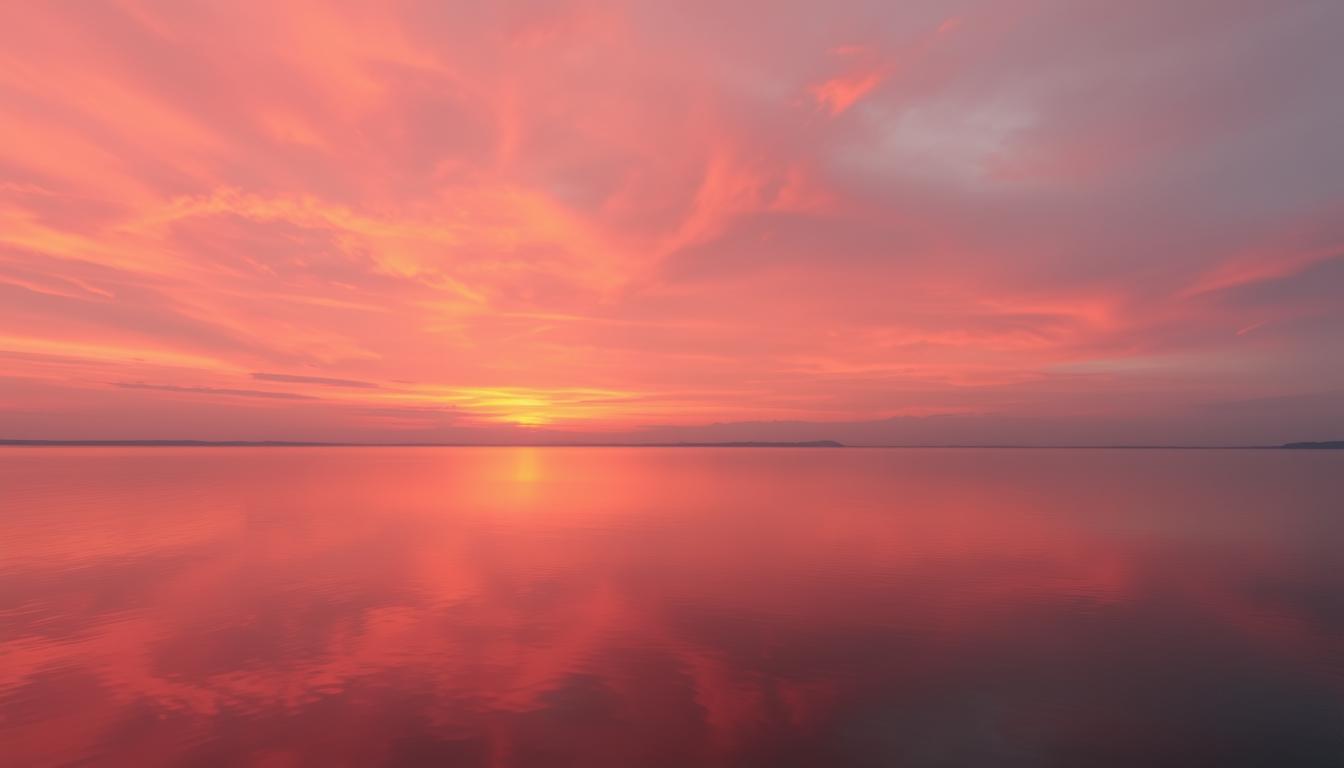
Have you ever stopped to watch the sky turn pink at sunset? This isn’t just a quick sight—it’s a reminder of nature’s beauty. It leaves us in awe. From the soft colors at dusk to the bold pinks of sunset, the sky captures our hearts.
Every day, the world paints its canvas above us. It invites us to pause and marvel. This is a moment we should never miss.
Recently, pink skies were seen in New Zealand and Australia. Volcanic eruptions caused these stunning visuals. These moments make us think about the science behind the colors and the stories they tell.
This article looks at the wonder of these changes. It mixes the science of light scattering with the emotional impact of nature’s art. Let’s explore why the sky’s colors move us. And how a simple evening sky can become a masterpiece.
The Science Behind the Color Change
As the sun sets, the sky turns pink and orange. This change is thanks to Rayleigh scattering. Blue light scatters a lot, but red and pink light travels further because they scatter less.
Light refraction also adds to the beauty. Sun rays bend as they go through the air, creating a rainbow. At sunset, this effect is even more stunning, making the colors pop.
“Late fall and winter offer the best sunsets in the eastern U.S. due to clearer skies and cooler air.”
Things like humidity and pollution also affect the colors. Water vapor can make the colors softer, while dust or smoke can create amazing hues. Even ice crystals in winter can make the colors brighter.
Scientists study how pollution changes these views. Cities with smog often have dull colors, but clean air brings out the full spectrum. Seasonal changes also play a part, making winter sunsets longer. So, the next time you see a pink sky, it’s science at work.
Timeless Moments: When the Sky Turns Pink
Seeing a pink sky is not just luck. It happens at certain times. The most beautiful views are at sunrise and sunset. During these golden hours, sunlight scatters, leaving us with a pink sky.

Seasons also matter. In spring and fall, the sun’s angle makes the light softer and colors more vivid. Clouds reflect and brighten the colors even more. Clear skies at dawn or dusk bring out the brightest pinks, while clouds add coral and lavender streaks.
“Seeing the sky turn pink feels like nature’s reminder to pause and appreciate the moment,” said a visitor to North Carolina’s Crystal Coast, a spot famous for its stunning pink horizons.
Timing is key. Early birds catch the sunrise, while sunset watchers enjoy the evening. Weather, like humidity, can change the intensity of the colors. Families often see these wonders on beach walks, laughing as the sky meets the sea.
Popular Locations to Witness Pink Skies
“The best sunset spots often feel like nature’s hidden gems—places where the sky becomes a canvas.” — National Geographic Photographer
Coastal cliffs and desert horizons across the U.S. are perfect for pink sky viewing. The Grand Canyon lights up with rose and gold at sunset, a favorite for photographers. Big Sur in California offers a rugged coastline with the Pacific Ocean’s reflection under a pink sky.
Sedona’s red rocks in Arizona frame sunsets in a surreal way, ideal for nature photography sites. These spots are where light dances freely, thanks to clean air and open spaces.
Overlook Beach in Maine and the Chugach Mountains in Alaska are hidden gems for sunset views. In 2023, Bengaluru’s skies turned pink due to a comet, showing even cities can have stunning sunsets. The Skyline Drive in Virginia has paved paths for easy access.
Death Valley is a must-see for desert sunsets against distant mountains. Whether it’s Lake Tahoe or the Badlands, these spots offer timeless and modern moments. Bring a tripod to capture the horizon’s surprise.
Photography Tips for Capturing Pink Skies
Mastering pink sky photography begins with knowing camera settings. For sunset photos, use a low ISO (100-200) to avoid noise. Set your aperture between f/8 and f/16 to keep your shots sharp. If you’re shooting for a long time, use a tripod.
Smartphone users can use pro modes to control exposure and white balance. This helps you get the best out of your device.

The golden hour is perfect for capturing vibrant colors. It’s the 30 minutes before and after sunset. Place yourself at a 45-degree angle to the horizon.
This lets trees or water reflect the sky’s colors. A circular polarizing filter can make colors more vivid. Neutral density filters help balance bright skies with darker landscapes.
“The best sunset photos balance timing with technique. Patience is key—wait for the sky to deepen into rich pinks before pressing the shutter,” advises landscape photographer Sarah Lin.
Smartphone photography can be great with apps like Lightroom Mobile. Use HDR mode to capture a wide range of colors. But don’t over-edit to keep the natural look.
For night nature shots, a 15-20 second exposure at ISO 1600 works well. This captures stars and twilight together. Always check the weather and respect protected areas.
Whether you have a DSLR or a phone, keep practicing. Try different frames and filters to capture the beauty of pink skies.
The Emotional Impact of Color in Nature
Color psychology reveals how colors affect our feelings. A pink sky’s soft colors bring us calm and wonder. The pink color meaning often stands for hope, reminding us to slow down and breathe.
Nature therapy uses these scenes to lower stress levels. A 1996 study showed pink cut aggression in most people. This matches how soft pinks in healthcare settings soothe patients. Even a short look at these colors can change our mood.
A 1996 study found bright pink reduced aggression in 151 out of 153 participants.
These natural beauty effects differ across cultures. Some see pink as joy; others as renewal. Yet, its calming effect is universal. Let’s colors remind us of nature’s healing and inspiring power. Next time you see a pink horizon, let it bring you gratitude or a smile.
Stories and Anecdotes: Memorable Pink Skies
Personal stories of pink sky experiences start with a simple glance up. A coworker’s memorable sunset turned the sky pink at 7:30 AM. Or a traveler saw a horizon ablaze after a volcanic eruption. These moments stay with us, connecting people through shared wonder.
In 1883, Krakatoa’s ash clouds painted skies worldwide for years. Recently, singer Zach Bryan’s song Pink Skies (out July 4, 2024) captures this beauty. It mixes fiction with real feelings, showing how these moments blend reality and art.
Sky watching knows no borders. A farmer in Iceland remembers a pink dawn after a storm. A teacher in Texas recalls a classroom gasp as clouds turned pink at recess. These moments show how skies tell silent stories. Bryan’s song, inspired by family, shows how stories capture universal truths.
Whether through songs, journals, or chats, these stories ask us to pause. Next time you see a pink horizon, let it start a story. Share it—a sunset’s glow fades, but its memory stays.
How to Experience the Pink Sky Phenomenon
Start by checking weather apps for clear best viewing times during sunrise or sunset. Look for open fields or hilltops for wide views. Local parks or rooftops with little light pollution are great spots. Don’t forget a blanket, sunscreen, and a thermos of tea to make it cozy.
Just your eyes are all you need to enjoy the view. No special gear required!
Make the most of sunset viewing by being mindful. Take deep breaths and watch as the colors change from gold to rose. Stay away from screens to fully enjoy the natural light.
Write down your thoughts in a journal or share the view with a friend. Some people like listening to soft music or reading a book while watching the sunset.
Remember to arrive early to get a good spot. Bring a flashlight for dawn walks. Always follow park rules to keep trails clean and respect others.
Try pairing sunset watching with activities like yoga or picnics. Keep track of when you see these beautiful skies to predict when they’ll happen again. With patience and curiosity, watching these moments becomes a special ritual for everyone.
Art Inspired by Pink Skies
Sky paintings and nature art have long captured the fleeting beauty of pink skies. From J.M.W. Turner’s vibrant sunsets to modern digital works, sunset inspiration fuels creativity. Artists use pink in artwork to convey emotion—from warmth to wonder—reflecting how these moments stir the soul.

“A pink sky isn’t just a backdrop; it’s a muse.” — Contemporary painter Elena Marquez
Artistic interpretations of pink skies span media. Turner’s The Fighting Temeraire glows with hues mirroring real-life sunsets. Today, Instagram artists like @SunsetBrushstroke share daily sketches of these moments. Even Disney’s Beauty and the Beast uses the Enchanted Rose’s bloom to symbolize transformation, much like how real pink skies inspire renewal.
Create your own nature art! Sketch a sunset, write a poem, or share your view online. Every brushstroke or photo becomes a tribute to nature’s ever-changing canvas.
Environmental Considerations
The air pollution effects on pink skies are complex. Particles like soot make colors pop, but too much pollution dulls them. Volcanoes or dust storms can create breathtaking views, but human pollution often takes over.
Climate change changes how air moves and holds moisture. This can make sunsets less colorful in places with more haze or smog.
Higher temperatures change clouds and humidity, affecting light in the sky. Even small increases in aerosols can mess with natural phenomena. But, human actions are the biggest problem.
Urban areas with lots of traffic can make sunsets look more intense. Yet, we need to care for our environment to keep these views alive.
Light pollution hides stars but doesn’t stop pink skies. Sadly, 99% of Americans live under skies that hide the stars. To keep these moments, we must cut down on pollution and artificial light. Cleaner air means future generations can see both beautiful sunsets and starry nights.
The Connection Between Weather and Sky Colors
Weather patterns and atmospheric conditions shape the skies we see each day. Cloud formations act like natural canvases, reflecting light in ways that create stunning hues. Meteorologists study how wind, temperature, and particles in the air combine to paint the horizon. Sunset prediction relies on understanding these factors, from dust storms to volcanic eruptions.

In 2022, a derecho over Sioux Falls turned skies green due to high-speed storms scattering light uniquely. A 2009 dust storm in Australia turned skies red-orange as particles altered sunlight paths. Even volcanic activity, like the 2022 Tonga eruption, left aerosols that lit Antarctic skies pink months later. These events show how atmospheric conditions transform ordinary days into vivid spectacles.
Scientists explain this through scattering: shorter blue wavelengths dominate daytime skies, while longer red and orange hues shine at dusk. Cloud types also matter—cirrus clouds, for instance, can amplify sunset colors. Observing weather patterns helps predict when these moments occur. A sailor’s saying—“red sky at night, sailor’s delight”—hints at real science: evening red skies often signal calm weather ahead.
“The sky’s palette is nature’s forecast,” says Dr. Elena Torres, a climatologist at NOAA. “Learning to read it connects us to Earth’s invisible forces.”
Tracking cloud formations and atmospheric changes can turn anyone into a backyard meteorologist. Next time you spot a pink horizon, consider the weather patterns at play—proof that science and beauty go hand in hand.
Conclusion: Embracing the Beauty of the Sky
Looking up is the first step to natural appreciation. Every sunset is like a masterpiece, mixing colors in a silent show. Mindful observation turns brief moments into lasting memories. Whether it’s the Grand Canyon or a city view, the sky’s colors ask us to pause and see beauty.
Starting a sky watching hobby connects us to nature’s wonder. A sunset with colors like twilight’s brush reminds us to cherish small joys. Next time you see clouds at dusk, let it spark your curiosity. Share your photos or track patterns with apps like SkEye. Every sunset is a chance to reconnect with the world’s quiet magic.
Remember the sun’s daily journey from dawn to night. Capturing these moments strengthens our connection to nature. Let the sky’s changing art inspire us to appreciate life’s fleeting beauty. The next sunset is coming soon—don’t miss its message of fleeting color and timeless grace.